Recently Mentioned Books
Showing 25 of 6845 mentions, ordered by most recent.

1. Hector Abad, Oblivion: A Memoir . A boy's, and then a man's, relationship with his father; it may put this bestselling Colombian author on the Anglo-American map.

5. Robert Schumann, Carneval, Kreisleriana, Arabeske, by Vassily Primakov .

4. Volkmar Andreae, conducting the Bruckner symphonies and Te Deum . Remastered mono from the 1950s, supposed to be perfection.

3. Dennis Russell Davies, conducting Haydn's complete symphonies . Elevated for the sake of completeness, no one is saying it is better than Dorati.

2. John Butt, conducting J.S. Bach, Mass in B Minor , Joshua Rifkin style. This is the recording which is supposed to convert the unpersuaded to the minimalist vocal approach.

1. Stephen Hough and Osmo Vanska, playing the Tchaikovsky piano concerti . This was the only item selected by three critics.

It is simply a first-rate book. It is out only in the UK, but I was happy to pay the extra shipping charge from UK Amazon, which you too can pay here . Or maybe try these used sellers . Some reviews are here .

That is from Paul Greenberg's Four Fish: The Future of the Last Wild Food .

I never loved this book before (sadly I cannot do serious reading in French), but now I do. Order it here . Reviews — mostly raves — are here . Right now Natasha is enjoying Davis's short fiction and I've ordered some of her other work as well.

Most of the book is intelligent, well-sourced, easy to read, and non-dogmatic. It is a "big book" on the scale of Jared Diamond or Paul Kennedy and the author is obviously highly intelligent. There is a good use of archaeology and mostly the author supports geographical theories of the rise of the West and other civilizations. It considers energy use, urbanization, and war-making explicitly, all pluses in my view. Eventually you realize it is going nowhere and has only a weak theoretical fra...

That is from Jane Smiley's new and worthwhile The Man Who Invented the Computer, The Biography of John Atanasoff, Digital Pioneer . My favorite part of the book was the discussion of Konrad Zuse , who deserves his own popular biography.

7. John Stuart Mill: Autobiography (yes, for economics) and his Some Essays on Unsettled Questions in Political Economy (Kindle edition is free). Mill has underrated depth as an economic thinker and he encompassed virtually all of the interesting trends of his time. That was both his greatest strength and his biggest weakness.

4. The early marginalists: I'll recommend Samuel Bailey on value and Mountifort Longfield on price theory . Yet still it was a (temporary) dead end and you should read them with that puzzle in mind. At what level of technical sophistication do the contributions of marginalism suddenly seem impressive?

4. The early marginalists: I'll recommend Samuel Bailey on value and Mountifort Longfield on price theory . Yet still it was a (temporary) dead end and you should read them with that puzzle in mind. At what level of technical sophistication do the contributions of marginalism suddenly seem impressive?

3. David Ricardo, Principles of Political Economy , the first six chapters. Rigor arrives, though at the expense of truth. Still there is something to it. Supplement with Mark Blaug on Ricardo , if you want the model spelt out mathematically.

The author is Steven Bryan, a historian, and the subtitle is Rising Powers, Global Money, and the Age of Empire . This book offers a great deal of previous unpresented information on the operation of the gold standard in Japan, Russia, Turkey, and Argentina, based on original rather than secondary sources. Here is a summary paragraph at the end of the book:

I spent about ninety minutes browsing this new book , but found it only moderately interesting, with more emphasis on the "moderately" than the "interesting." If you're obsessed with Twain, you'll find it worth the $20, but the above paragraphs sum up the main problem with the text.

It is a very powerful book and I can recommend this review and this review . Along somewhat related lines, some of you may wish to read Paul R. Gregory's Politics, Murder, and Love in Stalin's Kremlin: The Story of Nikolai Bukharin and Anna Larina . Bukharin, of course, was also an economist. Here is Gregory on the book . Here is Gregory on Germany's currently low unemployment rate .

The author is Timothy Snyder and the subtitle is Europe Between Hitler and Stalin . I learned that this period was even bloodier and more brutal than I had thought:

Mortensen has a whole book on wage dispersion , reviewed here . The key question is why workers with similar characteristics often are paid differently and the answers lie in job search frictions.

Diamond has written a great deal on social security, often at the applied level. Here is his paper criticizing social security privatization in Chile for its high costs. Here is his survey on social security reform proposals . Here is his paper on macro and social security reform . Here is a very good European talk he gave on pension issues. Diamond wrote a book with Peter Orszag on social security and he has been a major influence on Democratic Party thinking on this issue; the book looks ...

I do the same, I should add. That passage is from Stanley Cavell, one of America's leading philosophers. If you're looking for a book which steps outside the usual mode of strict narrative, I recommend this highly, but it will leave many people frustrated. You can buy it here .
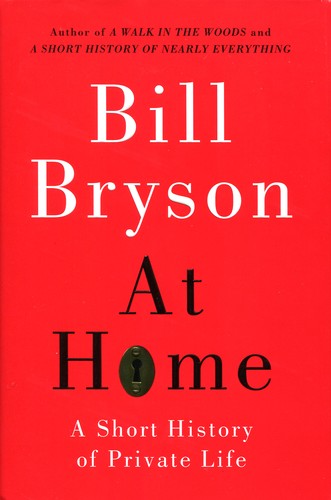
That is all from the new Bill Bryson book , subtitled A Short History of Private Life , which is both entertaining and informative.

That's for literature , sadly he never had the chance to win a prize for economics, as his political career as a Peruvian classical liberal was cut short by electoral defeat. He has many fine books but I have two particular favorites: The War of the End of the World (serious and epic, concerning a millenarian revolt in Brazil) and Aunt Julia and the Scriptwriter (a fun story and spoof of telenovela culture). Conversation in the Cathedral is sometimes considered a classic but I find it unreadabl...

That's for literature , sadly he never had the chance to win a prize for economics, as his political career as a Peruvian classical liberal was cut short by electoral defeat. He has many fine books but I have two particular favorites: The War of the End of the World (serious and epic, concerning a millenarian revolt in Brazil) and Aunt Julia and the Scriptwriter (a fun story and spoof of telenovela culture). Conversation in the Cathedral is sometimes considered a classic but I find it unreadabl...