Recently Mentioned Books
Showing 25 of 6845 mentions, ordered by most recent.

You may remember our very successful book forum on Greg Clark’s A Farewell to Alms . In short, we all read the book together and I offered running commentary on the contents. There was a special encouragement for reader comments, and Greg very graciously responded at length. Next Alex and I, along with some specially invited guest bloggers, will be doing Tim Harford’s new The Logic of Life: The Rational Economics of an Irrational World . Tim’s book won’t be out until January 15, so of course...

Everything .

That is from In the Company of Crows and Ravens , a fascinating book. Most of all this volume stresses how much crows have co-evolved with humankind.

John’s new book War, Wine, and Taxes sells new for $29.95 on Amazon [TC: this is correcting a previous mistake in listing the price], with free shipping in the U.S. Many of the used copies of John’s book are selling for over $30, others in the $25-30 range, and the shipping charges are higher than Amazon’s. Last I looked , none of the forty used copies were selling for less than $25 and one was selling for $50.

Buy it here , or here on Amazon . The Board of Editors included Russ Roberts and myself, and the publisher is Liberty Fund.

That is from Fabio Rojas’s new and noteworthy From Black Power to Black Studies: How a Radical Social Movement Became an Academic Discipline . Here is Bryan Caplan’s review of the book .

In its first Asian guide , announced on Monday, Michelin has awarded more of its famed stars to Tokyo restaurants than any other city, with a total of 191 stars compared with 64 for Paris and 42 in New York.

6. Single song on iTunes : Anthony and the Johnsons, Knockin’ on Heaven’s Door. The key here is to pick a song on an album you won’t otherwise buy or you won’t otherwise think of.

5. DVD : I watched through Planet Earth as quickly as I could . Yana then took the box up to college, if you need another testimony. If your loved one doesn’t merit an entire DVD box, I thought Away From Her was the best movie of the year; sadly the first-rate No Country for Old Men won’t be ready on disc in time.

5. DVD : I watched through Planet Earth as quickly as I could . Yana then took the box up to college, if you need another testimony. If your loved one doesn’t merit an entire DVD box, I thought Away From Her was the best movie of the year; sadly the first-rate No Country for Old Men won’t be ready on disc in time.

3. Classical music : Either William Byrd, Laudibus in Sanctus , beautifully recorded, or John Adams, The Dharma at Big Sur/My Father Knew Charles Ives , and yes I spent twenty years as a Johns Adams skeptic. In the last few years he’s raised his music to an entirely new level.

3. Classical music : Either William Byrd, Laudibus in Sanctus , beautifully recorded, or John Adams, The Dharma at Big Sur/My Father Knew Charles Ives , and yes I spent twenty years as a Johns Adams skeptic. In the last few years he’s raised his music to an entirely new level.

2. Popular Music : The View, Hats off to the Buskers , from Scotland, this is musically superior pop and they still have room to get even better.

1. Fiction : Stephane Audeguy, Theory of Clouds . The conceptual foreign novel which got lost in the shuffle of the American fiction market.

That is from Albert Sanchez Piñol’s Cold Skin , a Catalan novel which is well known in Europe (I discovered it browsing a Swiss bookstore) but obscure in the United States. It captivated me right away. I cannot quite call it science fiction, but I would recommend it to science fiction and horror fans who are looking for something serious and conceptual and literary, and who feel that only scraps remain on the table…

5. The Feast of the Goat , by Mario Vargas Llosa. One of the best studies of the psychology of political power and the connection between tyranny and the erotic. A fun albeit sometimes harrowing read. Another superb translation by Edith Grossman, might she be the best translator ever?

4. Dark Sun: The Making of the Hydrogen Bomb , by Richard Rhodes. This favorite book of Jason Kottke is first-rate non-fiction, it is also one of the best books on the Cold War.
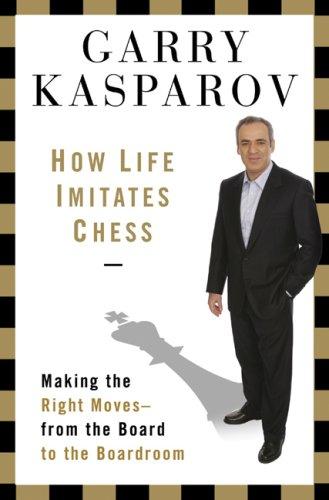
3. How Life Imitates Chess: Making the Right Moves, from the Board to the Boardroom , by Garry Kasparov. This is a fun book, except that life mostly doesn’t imitate chess. Chess is characteristic for its lack of self-deception; it is hard to avoid knowing where you stand in the hierarchy and excuses are few and far between. That’s why most chess players are depressed. Kasparov seems to save his self-deception for politics; let’s hope he is still alive a year from now.

2. The Stillborn God: Religion, Politics, and the Modern West , by Mark Lilla. Why Schleiermacher really matters, how Kant painted himself into a corner trying to solve the problems laid out by Rousseau, and why it all springs from Hobbes. I found this well above average for its genre, though you must have a taste for Straussian-like books where big ideas clash at the macro level and there is little attempt at any kind of empirical resolution.

1. Love, Life, Goethe: Lessons of the Imagination from the Great German Poet , by John Armstrong. The author does not demonstrate overwhelming expertise but this is nonetheless not a bad place to start on the most neglected of all the great writers.

Here is the link and story . Along related lines, I found Sarah Maxwell’s The Price is Wrong: Understanding What Makes a Price Seem Fair and the True Cost of Unfair Pricing to be a stimulating collection of anecdotes on this issue. Here is my previous post on the iPhone and price resentment .
Here is the full post , which also covers Tim Harford’s forthcoming The Logic of Life , which you’ll hear more about in due time (it carries a blurb and recommendation from yours truly).

That is from Randall Collins, Violence: A Micro-sociological Theory . Here is my previous post on the book . By the way, if you find questions like this interesting, it is yet another reason to watch the TV show Friday Night Lights .

That is from Randall Collins, Violence: A Micro-sociological Theory . Here is my previous post on the book . By the way, if you find questions like this interesting, it is yet another reason to watch the TV show Friday Night Lights .

That’s from Robert Reich’s Supercapitalism . I’m coming late to this party, but mostly I liked the book. It’s full of fresh thinking and most of all it is excellent on just how much invisible hand mechanisms shape an economy. It has the best explanation (and partial defense) of high CEO pay I’ve seen, namely supply and demand. If you think it is exploitation of shareholders, take a look at how much private equity pays its CEOs. And as the above quotation indicates, Reich is willing to rethi...